Mingqian Ma 马鸣谦
I am a master's student at Carnegie Mellon University, advised by Prof. Jian Ma, and a research intern in AI for Science at the Shanghai Artificial Intelligence Laboratory. My research focuses on genomic foundation models and AI for biological design. I am the first and a core author of CENO, a genome-scale world model that unifies long-context sequence understanding, evolutionary variant interpretation, and programmable regulatory design.
My work follows a continuous line from HybriDNA to GO-CRE and CENO: building efficient long-context DNA models, turning evolutionary and functional feedback into sequence design, and validating model-generated regulatory elements experimentally. I also build scientific agents for reproducible research workflows.
Previously, I was a research intern at Microsoft Research AI for Science with Dr. Guoqing Liu, where I worked on HybriDNA and NatureLM. Before that, I completed a dual-degree program — a BSE in Computer Science & Engineering at the University of Michigan and a BE in Electrical & Computer Engineering at Shanghai Jiao Tong University.
News
- Aug 2026 New Perspective: Towards human-led, agent-driven autonomous laboratories for the life sciences — a collaboration between Prof. Jian Ma's group at CMU, Aviv Regev's team at Genentech, and Medra AI.
- Jul 2026 We released CENO at WAIC 2026, together with its technical report, code, and open model checkpoints.
- Jul 2026 New preprint: GO-CRE — interpretable and tunable cis-regulatory element design with lentiviral MPRA validation.
- Jul 2026 SkillFoundry was accepted to COLM 2026.
- May 2026 New preprint: AgentCo-op — retrieval-based synthesis of interoperable multi-agent workflows.
- Mar 2025 Our optical multilayer thin-film inverse design survey was accepted by iScience.
- Feb 2025 HybriDNA and the NatureLM project I contributed to at MSR are now on arXiv.
- May 2024 Joined Microsoft Research AI4Science as a research intern, working on pretraining large-scale DNA foundation models with Dr. Guoqing Liu.
Research
I build genomic foundation models that connect long-context sequence understanding, evolutionary reasoning, and programmable biological design.
Current questions: how can one generative model read, score, and write DNA across nucleotide-to-megabase scales? How can evolutionary and experimental feedback make biological sequence design more interpretable and reliable? I also study scientific agents that turn models, tools, and data into reproducible research workflows.
Publications
* denotes equal contribution unless stated otherwise. Full list on Google Scholar.
Genome Models & Biological Design
-
CENO: A Genome-Scale World Model for Evolutionary Sequence Interpretation and Programmable Regulatory Design
Technical Report, 2026
paper · code · website · models
CENO is a family of long-context generative genomic world models that uses one autoregressive backbone to understand long DNA, score mutation effects with evolutionary context, and design regulatory sequences. Its staged curriculum reaches one-million-token whole-genome context, while evolutionary post-training and reinforcement-learning-guided design connect sequence interpretation with programmable biological function.
-
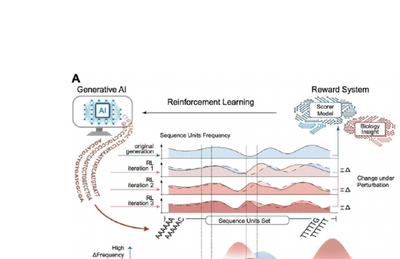
Reconstructing sequence-grammar trajectories enables interpretable and tunable cis-regulatory element design
bioRxiv, 2026
GO-CRE combines efficient sequence generation, predictor-guided reinforcement learning, and trajectory-level interpretation to make cis-regulatory element design interpretable and tunable. Sequence-grammar trajectory reconstruction exposed a low-complexity polyG trap and enabled biologically informed reward shaping, while lentiviral MPRA validated cell-type-specific activity in K562 and HepG2.
-
Reverse-Complement Consistency for DNA Language Models
ArXiv, 2025
A simple fine-tuning recipe for Reverse-Complement Consistency tasks for DNA language models.
-
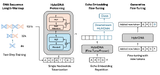
HybriDNA: A Hybrid Transformer-Mamba2 Long-Range DNA Language Model
ArXiv, 2025
Advances in natural language processing have inspired new approaches to modeling DNA, often called the “language of life.” However, DNA modeling requires handling ultra-long sequences with single-nucleotide precision and excelling in both generative and understanding tasks. We introduce HybriDNA, a decoder-only DNA language model that combines Transformer and Mamba2 architectures to efficiently process sequences up to 131kb. HybriDNA achieves state-of-the-art performance across 33 DNA understanding benchmarks and excels in generating synthetic regulatory elements. Our findings highlight its scalability from 300M to 7B parameters, demonstrating its potential to drive new discoveries in DNA research and applications.
-
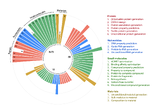
NatureLM: Deciphering the Language of Nature for Scientific Discovery
ArXiv, 2025
NatureLM, developed by Microsoft Research AI for Science, is a groundbreaking sequence-based science foundation model designed to unify multiple scientific domains, including small molecules, materials, proteins, DNA and RNA. This innovative model leverages the “language of nature” to enable scientific discovery through text-based instructions.
Scientific Agents
-
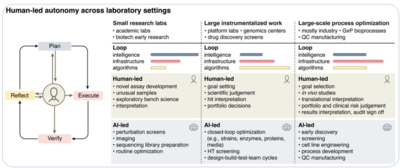
Towards Human-Led, Agent-Driven Autonomous Laboratories for the Life Sciences
Preprints.org, 2026
This Perspective distinguishes scripted automation from flexible, AI-enabled autonomy and outlines a staged roadmap toward human-led, trustworthy self-driving labs for biology. We define laboratory autonomy as a bounded control loop — scientists set goals and constraints, agents plan and coordinate experiments, instruments execute and report machine-checkable evidence, and humans verify, interpret, and govern high-consequence decisions. We map the lab-side failure modes that create a persistent reality gap — silent failures, temporal drift, contamination, sample mix-ups, ambiguous protocol intent — and argue for verifiability-first autonomy that empowers rather than replaces human creativity and judgment.
-
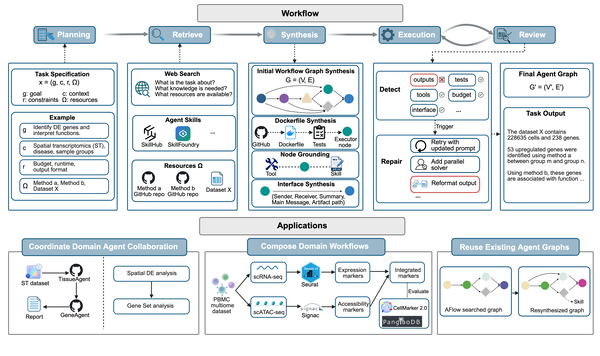
AgentCo-op: Retrieval-Based Synthesis of Interoperable Multi-Agent Workflows
ArXiv, 2026
AgentCo-op composes reusable components — skills, tools, and external agents — into executable multi-agent workflows through retrieval-based synthesis with typed artifact handoffs, applying bounded self-guided local repair when execution reveals failures. On genomics case studies, independently developed scientific agents and tool repositories coordinate without redesign; the framework also generalizes to coding, math, and question answering, achieving the best results on four benchmarks under a unified backbone while reducing per-task cost relative to multi-agent baselines.
-
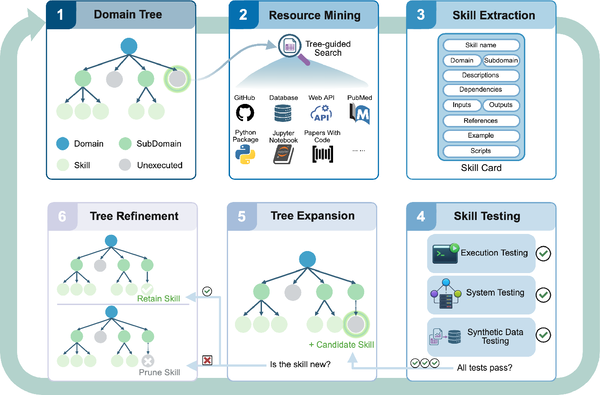
SkillFoundry: Building Self-Evolving Agent Skill Libraries from Heterogeneous Scientific Resources
Conference on Language Modeling (COLM), 2026
SkillFoundry converts heterogeneous scientific resources — repositories, APIs, scripts, and documentation — into validated, reusable agent skills. The framework organizes scientific domains as knowledge trees, extracts operational contracts, compiles executable skill packages, and refines them through iterative validation. 71.1% of mined skills are novel relative to existing libraries, and they meaningfully improve agent performance on genomics workflows including cell-type annotation and scDRS.
Education & Experience
- Dec 2025 – Present Shanghai Artificial Intelligence Laboratory · Research Intern, AI for Science; first and core author of CENO
- 2025 – Present Carnegie Mellon University · M.S., advised by Prof. Jian Ma
- 2024 – 2025 Microsoft Research · Research Intern, AI for Science, with Dr. Guoqing Liu
- 2023 – 2025 University of Michigan · BSE in Computer Science & Engineering, advised by Prof. L. Jay Guo
- 2021 – 2025 Shanghai Jiao Tong University · BE in Electrical & Computer Engineering, advised by Prof. Xiaofeng Gao
Service
- 2026 Reviewer · NeurIPS
- 2025 Reviewer · ICLR